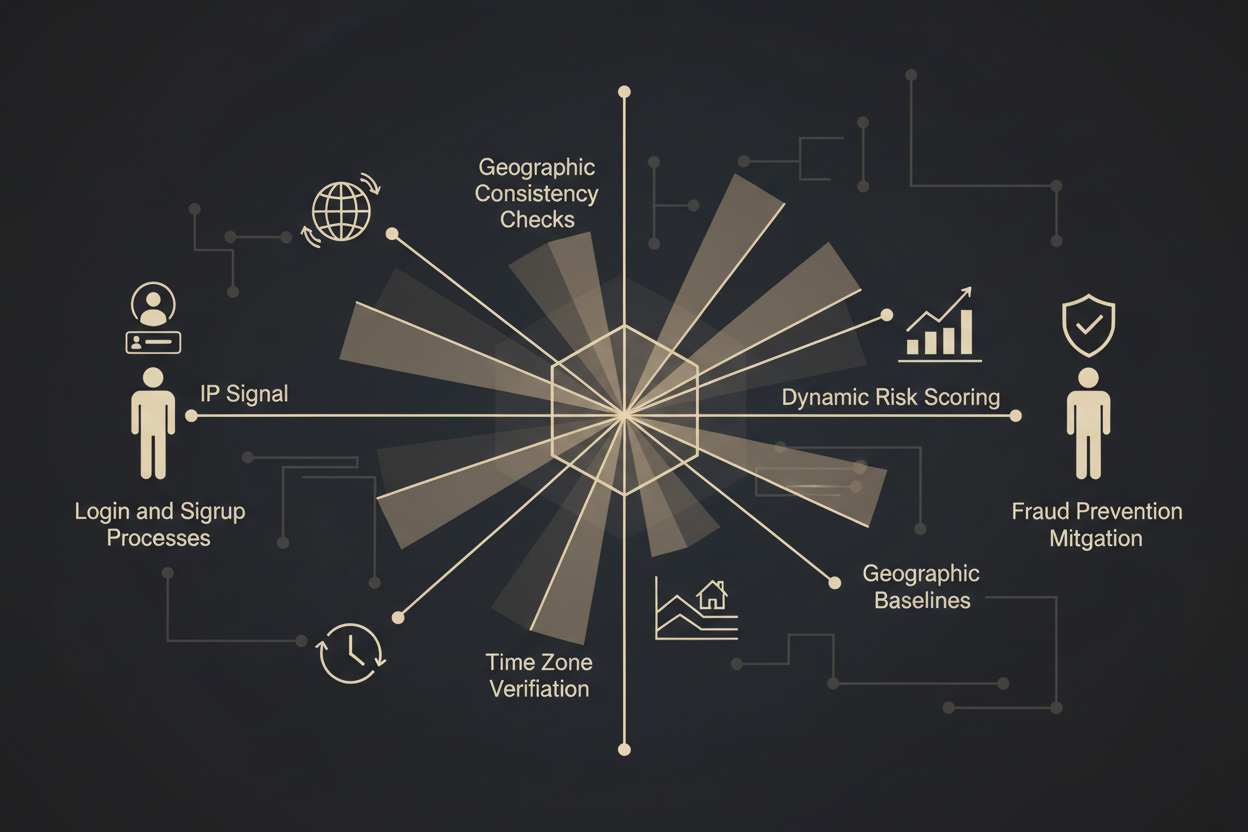
GeoIP Antifraud Patterns for Login and Signup: Advanced Techniques for Fraud Prevention
Introduction: Addressing Fraud in Login and Signup Processes
Fraudulent login and signup attempts pose significant risks to businesses. These risks include account takeovers, fake account creation, and abuse of platform services. A scientific approach leveraging GeoIP intelligence can detect anomalies and mitigate these challenges effectively. This article explores the architectural underpinnings of GeoIP antifraud patterns tailored for robust login and signup flows.
Why GeoIP Patterns Are Integral to Fraud Prevention
GeoIP data captures precise user location attributes by mapping IP addresses to geographical information. These patterns are instrumental in identifying mismatches between expected user behavior and actual activity, such as login attempts from anomalous regions, velocity-based IP changes, and impossible travel scenarios. Such insights enhance risk scoring models and make real-time decisions in fraud prevention workflows.
Common Questions Users Ask When Implementing GeoIP Antifraud Patterns
- How can I block login attempts from high-risk regions?
- What metrics can detect suspicious signup behavior?
- How do I combine GeoIP with behavioral signals for fraud detection?
- How should I structure my API calls to comply with GeoIP antifraud workflows?
- What are the pitfalls when designing GeoIP-based trust and risk models?
GeoIP Patterns for Login Flows
1. IP Address and Geographic Consistency Checks
One of the simplest yet effective antifraud patterns for login involves validating the IP address of the user against previous session data. Here's how:
- Retrieve the user's prior login IP and associated geographic location from your database.
- Cross-reference with the current login attempt's GeoIP data.
- Set specific thresholds for acceptable geographic drift (e.g., within 30km radius for urban areas).
For implementation code details on GeoIP in server-side frameworks, refer to GeoIP in Node.js Express and NestJS: real time risk gates before payment and login.
Anti-pattern: Avoid solely blocking users based on geographic changes without correlation to prior behaviors, as this can increase false positive rates.
2. Impossible Travel Detection
Impossible travel occurs when a user’s IP shifts geographically in ways that defy realistic travel times. You can implement this detection as follows:
- Track login timestamps and IP-derived geolocations.
- Calculate travel speed by comparing consecutive login events.
- Flag or block events exceeding reasonable travel boundaries (e.g., over 1,500 km/hour).
For advanced fraud scoring strategies, see Fraud scoring architecture: combining IP reputation, geo anomalies, and behavioral signals.
GeoIP Patterns for Signup Flows
1. User Origin Validation
Monitoring the origin of signups using GeoIP ensures that accounts are not created en masse from unusual or flagged geographic regions. Here’s a structured method:
- Define a list of trusted countries or regions for your platform.
- Validate the GeoIP country code during the signup API call.
- Use allowlists for corporate VPNs or permitted proxies common to enterprise users.
For practical examples on integrating GeoIP middleware, see GeoIP in Laravel: middleware for risk aware auth, checkout, and account changes.
2. IP Velocity and ASN Volatility Detection
Fraudulent accounts often originate from rapidly-shifting IP addresses or volatile Autonomous System Numbers (ASN) associated with proxies. Implement detection steps such as:
- Track multiple signups from the same IP within a specific timeframe.
- Use GeoIP APIs to examine ASN ownership and volatility for every signup.
- Flag IPs that rotate excessively between ASNs linked to known proxy providers.
For more on similar detection techniques, see How to detect multi account farms using user_id linkage and IP graph heuristics.
Checklists for Implementation
Login Flow :
- ✅ Implement GeoIP session tracking for consecutive login comparisons.
- ✅ Configure impossible travel detection thresholds in your fraud rules.
- ✅ Monitor failed login counts tied to high-risk IP regions.
Signup Flow:
- ✅ Examine ASN and IP consistency in real-time using GeoIP.
- ✅ Validate geographic region against allowlists.
- ✅ Monitor IP velocity for multiple signups within single entities.
Potential Pitfalls (Anti-Patterns) to Avoid
- ❌ Rigid GeoIP blocks without adaptive allowlists lead to higher false positives.
- ❌ Ignoring behavioral signals alongside GeoIP increases blind spots in fraud detection.
- ❌ Over-reliance on legacy IP blocklists instead of utilizing real-time GeoIP intelligence.
Conclusion and Call to Action
Combining GeoIP antifraud patterns with advanced behavioral and velocity analysis can significantly thwart fraudulent activities at both login and signup stages. By adopting these evidence-based guidelines into your architecture, you can establish more secure customer authentication and protect your platform from malicious actors.
To implement these techniques and protect your systems with GeoIP-based antifraud workflows, access our API and tools through the dashboard today.
Related reads
Advanced GeoIP Fraud Detection Strategies
3. Time Zone and Device Locale Cross-Verification
Another critical GeoIP-based approach is combining geographic location with user system settings, such as time zone and device locale. These data points provide additional layers to validate user authenticity. For instance, discrepancies between GeoIP-detected time zones and device-reported time zones could indicate potential fraud. To implement:
- Capture the user's device-reported time zone and locale during login or signup processes.
- Cross-match this data with the GeoIP-derived location.
- Analyze discrepancies, particularly when combined with other risk indicators, to score or flag sessions.
Pro Tip: Regularly inform legitimate users about such verifications to ensure better transparency and trust in your platform.
4. Pattern Analysis for Geographic Access Trends
Studying consistent geographical access patterns can help differentiate legitimate users from bad actors. Creating geographic baselines for specific user cohorts allows identification of potential anomalies. Implementation steps include:
- Segment your users based on expected geographic behaviors (e.g., regional customers versus global enterprise accounts).
- Establish baseline GeoIP trends for each cohort using historical login and session data.
- Flag access attempts that deviate significantly from these baseline trends.
This method is particularly effective for businesses serving highly localized customer bases, as geographic anomalies can be an early marker for exploitation attempts.
Enhancing Risk Models with GeoIP Metrics
Real-Time Integration with Scoring Engines
GeoIP data becomes most valuable when integrated into dynamic scoring mechanisms that evaluate fraud risks in real-time. Incorporate the following best practices:
- ✅ Populate risk engines with GeoIP flags (e.g., suspicious locations, ASN volatility, known proxies).
- ✅ Use GeoIP velocity, geographic clusters, and device-origin match data to derive quantifiable risk scores for each event.
- ✅ Continuously refine thresholds for alerts based on evolving attack strategies.
By combining these GeoIP metrics with behavioral analysis—such as session duration, click rates, and the sequence of interface interactions—you can create comprehensive fraud profiles to detect abnormal behaviors preemptively.
Geo-Enforced Multi-Factor Authentication (MFA)
Geo-location can also serve as an intelligent MFA trigger. When GeoIP flags unusual logins, an additional authentication challenge can be issued for verification:
- Require one-time codes sent to registered emails or phone numbers when suspicious GeoIP activity is detected.
- For higher-value transactions, prompt biometric verification or challenge questions based on user-generated answers.
MFA tied to location-based triggers provides targeted security reinforcement without impacting legitimate user experiences unnecessarily.
Operationalizing GeoIP Data: A Development Checklist
Adopting GeoIP antifraud patterns requires disciplined development practices to ensure accuracy and system responsiveness. The following checklist will help operationalize GeoIP capabilities effectively:
Backend Development:
- ✅ Implement asynchronous GeoIP lookups to minimize latency impact on user workflows.
- ✅ Cache frequently used GeoIP lookup results to reduce API request loads.
- ✅ Design APIs capable of handling multiple lookup responses (e.g., ASN, country code, and threat intelligence).
Data Management:
- ✅ Periodically audit GeoIP datasets for accuracy, particularly as ASN information changes over time.
- ✅ Apply data normalization techniques to compare GeoIP results with other location metadata effectively.
Monitoring and Reporting:
- ✅ Build automated alerting systems for high-risk GeoIP patterns (e.g., new logins from clusters flagged in threat databases).
- ✅ Generate periodic reports on GeoIP fraud markers to identify evolving attack patterns in your system.
Customizing GeoIP Defenses for Business Needs
While GeoIP fraud patterns offer robust protection frameworks, they must be tailored to each organization's specific risk exposure. Here are some considerations when customizing defenses:
- Evaluate user trust baselines: Identify geographic locations where legitimate users might differ due to travel or relocation.
- Incorporate industry-specific intelligence: For instance, financial platforms should integrate location patterns tied to ATM hotspots or financial hubs.
- Adapt for regulatory compliance: Ensure that GeoIP-based decision processes align with data handling and privacy regulations (e.g., GDPR).
By aligning GeoIP defenses with business operations, you ensure seamless integration that enhances fraud detection without disrupting user experiences unnecessarily.
Continuous Improvement: Feedback Loops Using GeoIP Analytics
Fraudsters continuously evolve their attack vectors, making it essential for your GeoIP antifraud systems to remain adaptive. Establishing feedback loops within your fraud prevention architecture ensures long-term efficacy:
- Log all flagged events for review and improvement opportunities.
- Use machine learning to analyze patterns in GeoIP deviations and refine scoring mechanisms.
- Conduct A/B tests to measure the customer impact of new GeoIP rules and thresholds.
These iterative processes will ensure your fraud prevention workflows remain agile and responsive to emerging threats.
Next step
Run a quick API test, issue your key, and integrate from docs.